
[Last Updated: May 2026]
Journal Contents:
- Where in the world are Amanitas found?
- Where is Amanita found in North America?
- What environment does Amanita grow in?
- Where can you find Amanita's growing?
- How to ID Amanita in the field?
- Where did Amanita muscaria first originate?
- Why the location affects the potency?
- FAQs
Amanita muscaria is one of the most recognizable mushrooms in the world and yet she is also one of the most specific about where and when she’ll grow. You can’t plant her, you can’t rush her, all you can do is to learn about her favorite environments to grow in, study the forests in your local area and show up at the right time.
This guide covers everything you need to know about where Amanita muscaria is found: the regions, the trees, the seasons, the subspecies, and how to identify it confidently in the field. It also covers what to watch out for (both the dangerous lookalikes, and the honest reality about potency variance)
Where in the World are Amanita Mushrooms found?
Amanita muscaria grows on every continent on Earth (except Antarctica) in both coniferous and deciduous forests. She is particularly abundant in the temperate and boreal forests of the Northern Hemisphere, such as across Europe, Russia, Siberia, and North America.
The best real-time visualization of her global distribution is the iNaturalist app, where foragers worldwide log their sightings. A screenshot of the global distribution map shows clear hotspots: the Pacific Northwest of North America (where Luminita sources her mushrooms), the boreal forests of northern Europe and Scandinavia, and pockets throughout Russia and Siberia, where her history of human use stretches back thousands of years. New Zealand has a notable presence as well, likely introduced with imported pine trees in the 19th century.

credit: inaturalist
Note: iNaturalist reflects where users of the app find mushrooms — not a perfect picture of true distribution. Countries with lower app usage are underrepresented.
Where Is Amanita Muscaria Found in North America?
North America has one of the richest Amanita muscaria populations in the world. It has been growing here long enough to diversify into distinct regional forms, which tells you something about how deeply rooted it is in this continent’s forests.
The map compiled by mycologist community members (combining data from iNaturalist, Mushroom Observer, and local mycologists) shows Amanita is found nearly everywhere in North America, with a thinner band through the Great Plains where forest cover is sparse. Coastal regions, the Pacific Northwest, the Northeast, the Great Lakes, the Rocky Mountains, and the Southeast all have strong populations.
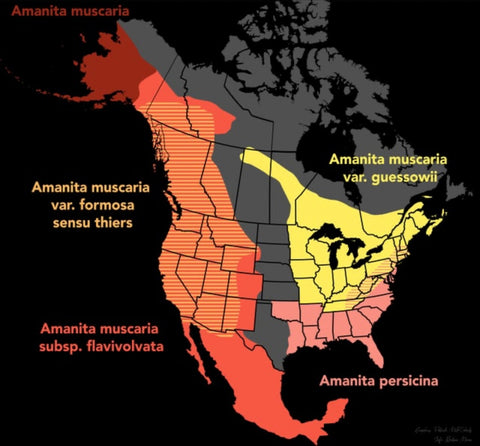
Photo Credit: u/mox911 on Reddit
The North American Subspecies
One of the most interesting and underappreciated facts about Amanita muscaria in North America is that she has diversified into several distinct regional forms. All contain ibotenic acid and muscimol and carry the same healing potential, but they all look quite different.
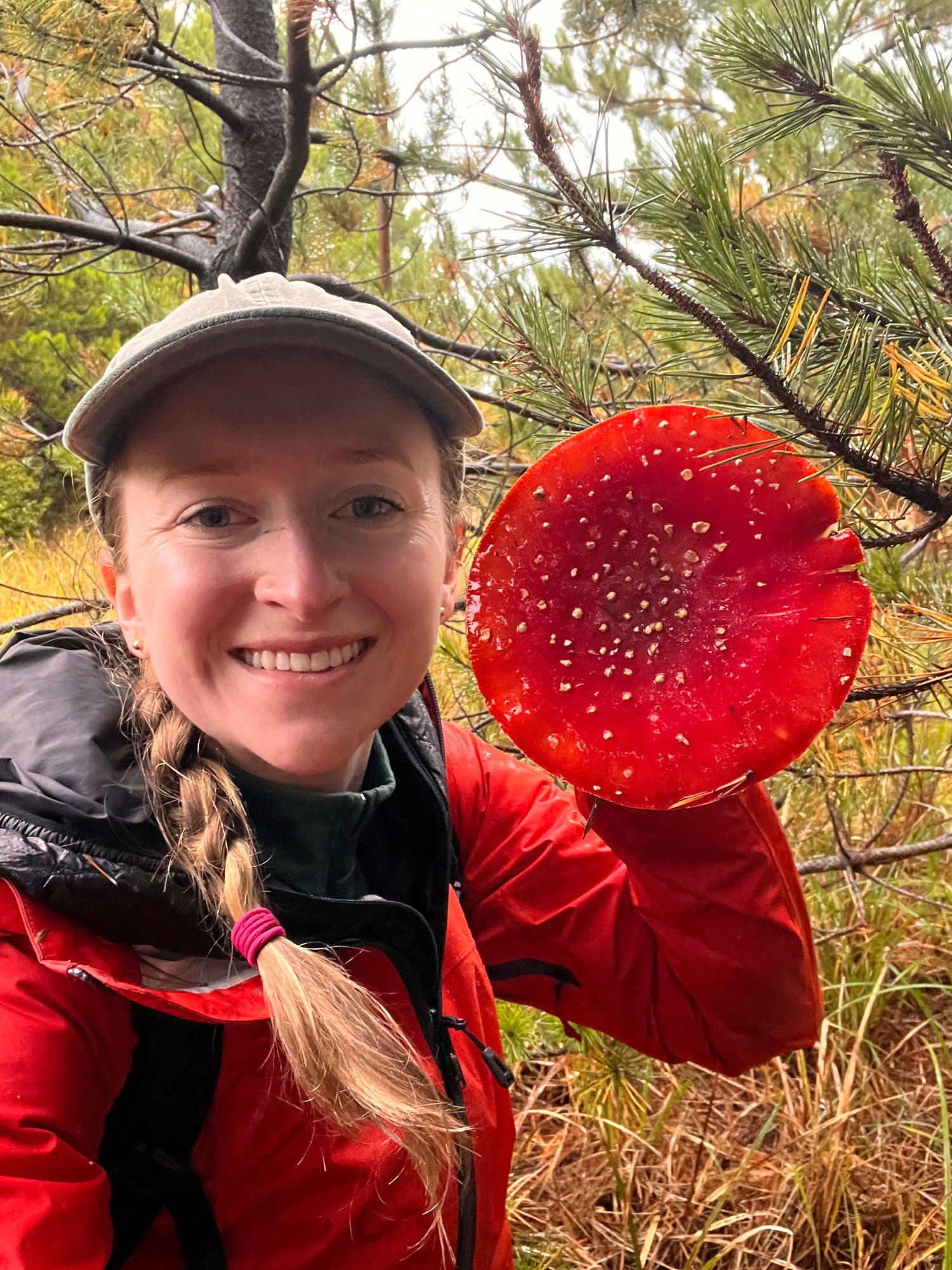
Amanita muscaria var. muscaria: The classic red-capped, white-spotted form most people picture. Found across much of western North America including the Pacific Northwest. This is the form Luminita forages.
Amanita muscaria var. flavivolvata: The dominant form throughout most of the western US and Canada. Distinguished by yellowish veil remnants when young that fade to white in sunlight. Cap color is red to orange-red. Essentially the western North American default.
Amanita muscaria var. guessowii: The eastern North American form. Yellow-orange to orange cap, fading with age. Structurally identical to the classic muscaria but with different pigmentation. Common in the northeastern US and Canada.
Amanita muscaria var. formosa: Orange to yellow-orange cap, sometimes reddish at the center. Found throughout North America. (Note: Some recent DNA research by mycologist József Geml and colleagues suggests that guessowii and formosa may ultimately be reclassified as polymorphic color variants rather than distinct subspecies. The taxonomy is still evolving.)
Amanita muscaria var. alba: A rare white to cream-colored form. Found in some areas of the Pacific Northwest and northern Europe. Contains the same active compounds.
Amanita persicina: Peach to dull reddish-orange cap. Found primarily in the southeastern US. Previously classified as an Amanita muscaria variant but reclassified as its own species. Still contains ibotenic acid and muscimol.
The takeaway: if you’re foraging in North America and encounter a non-red Amanita with white gills, white stem, concentric rings at the volva, and a ring skirt, don’t dismiss it, it may still be Amanita muscaria, just in a regional color variant.
What Environment Does Amanita Muscaria Grow In?
- Pine (Pinus spp.): especially in the Pacific Northwest and western North America
- Birch (Betula spp.): especially in northern Europe, Siberia, and northeastern North America
- Spruce (Picea spp.)
- Fir (Abies spp.)
- Oak (Quercus spp.): in certain regions
- Cedar: in some Pacific Northwest settings
What Does the Soil Tell You?
When can you find Amanitas growing?
Amanita muscaria can technically be found year-round, but the foraging season has a clear peak.
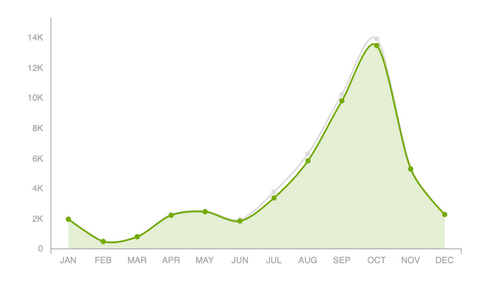
credit: Inaturalist
How to Identify Amanita Muscaria in the Field
Amanita muscaria is one of the easier mushrooms to identify in her classic form, but the color variants and her dangerous relatives within the Amanita genus make careful observation essential.
Key Identifying Features
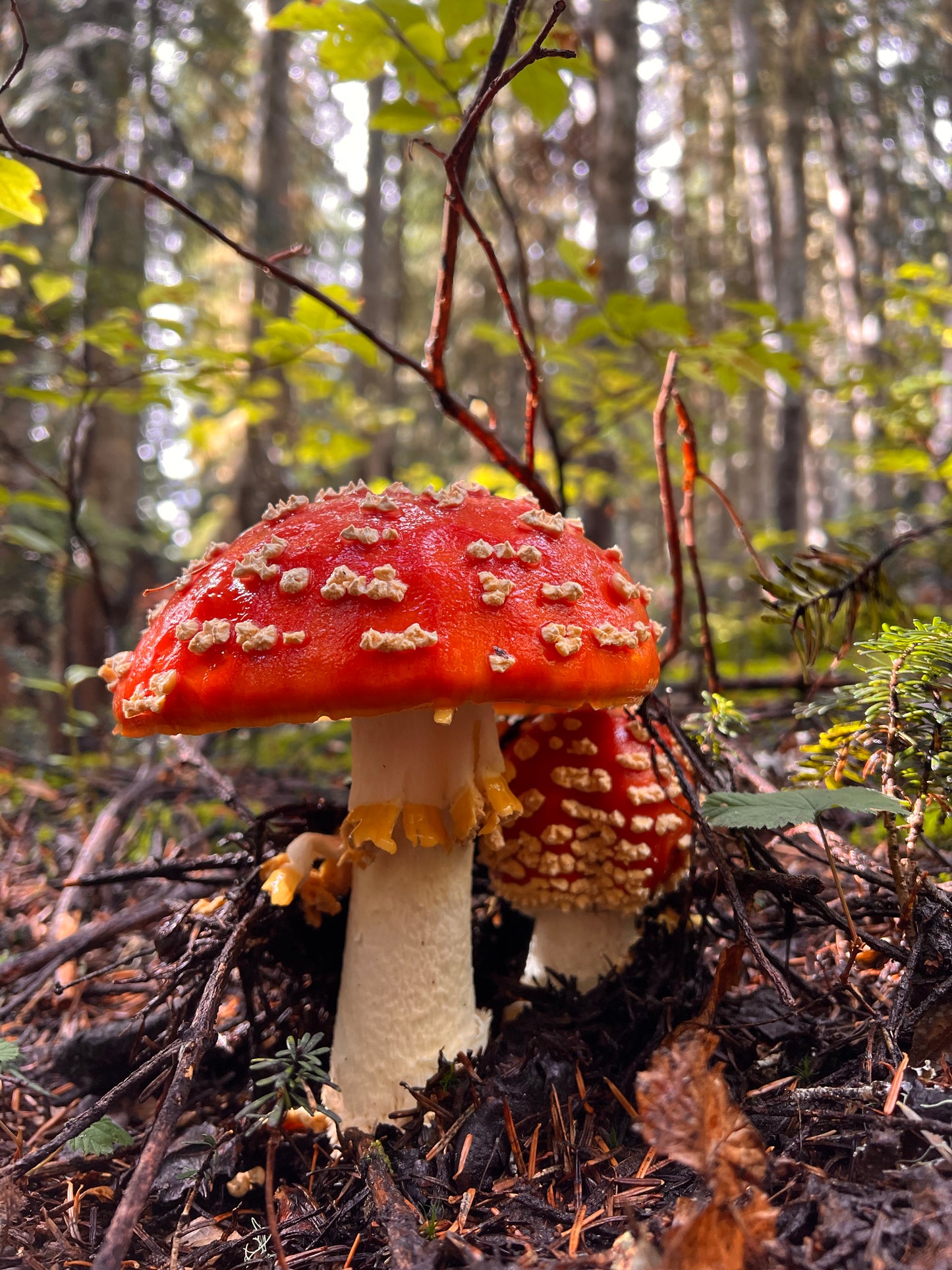
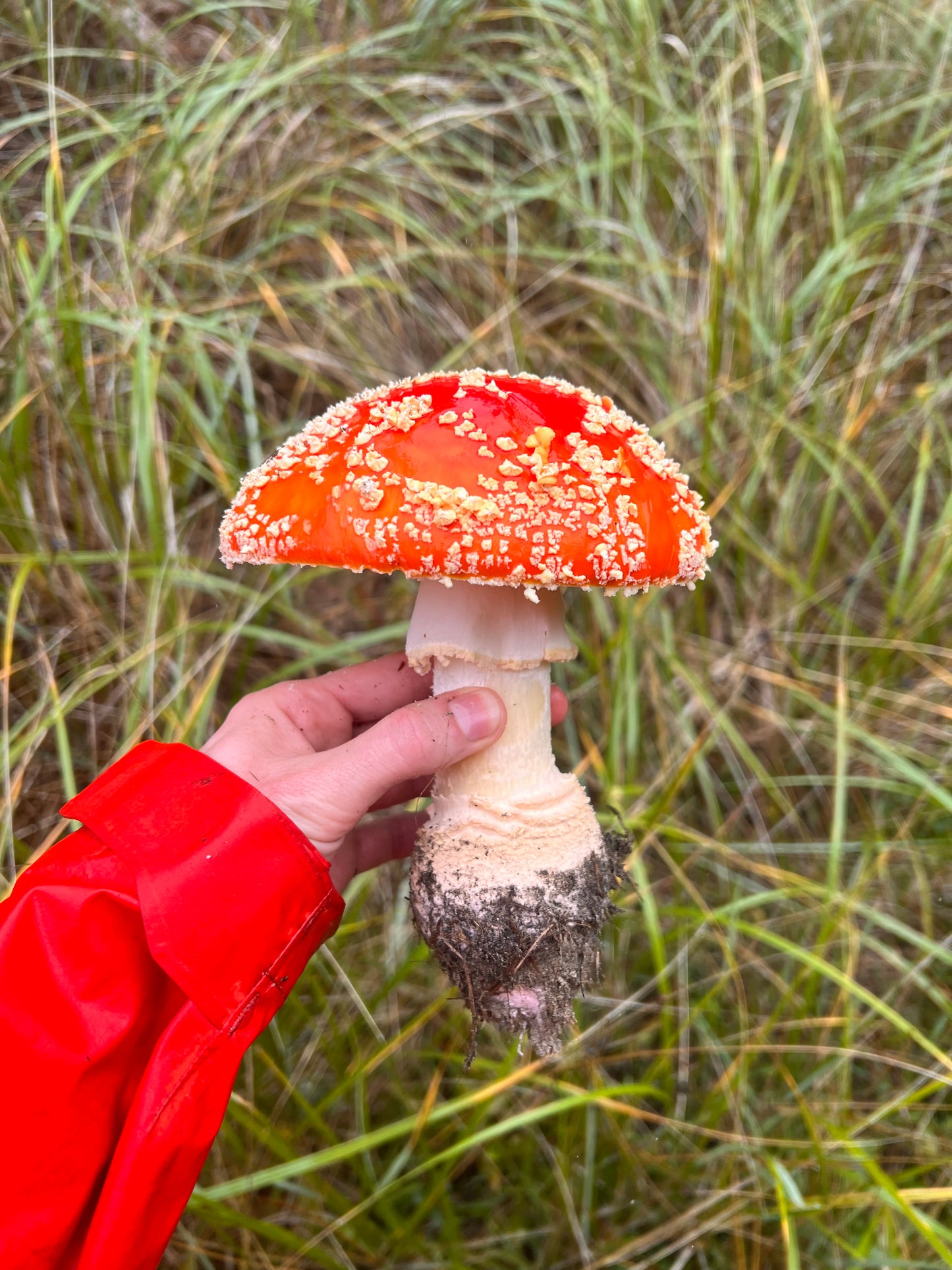
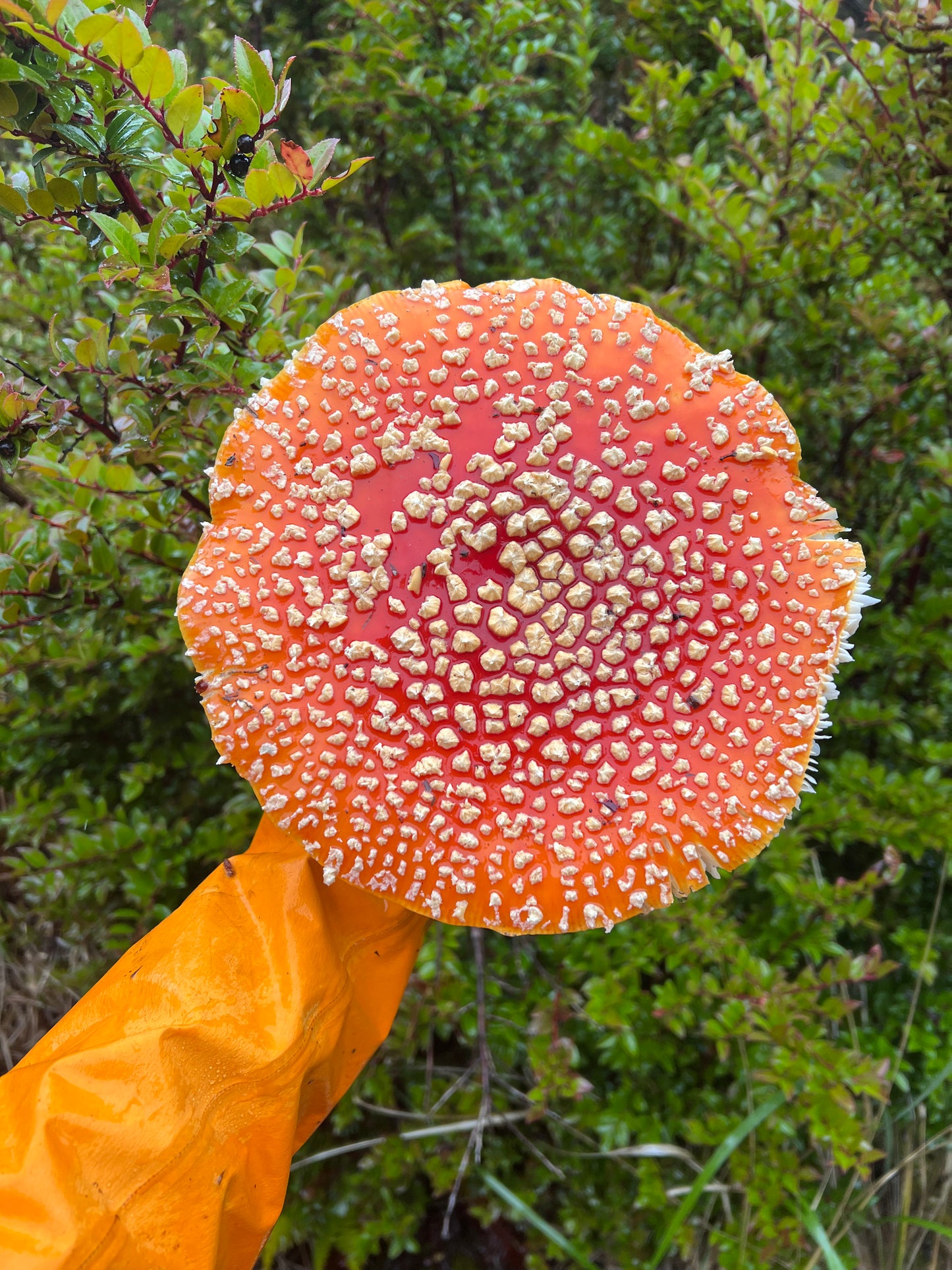
Cap: 5–20 cm in diameter. The classic form is bright red to scarlet, but color variants include orange, yellow-orange, and pale yellow. Initially it is round and convex, but flattens quickly with age. The surface is covered with white to pale yellowish warts, remnants of the universal veil that ruptures as the mushroom expands.
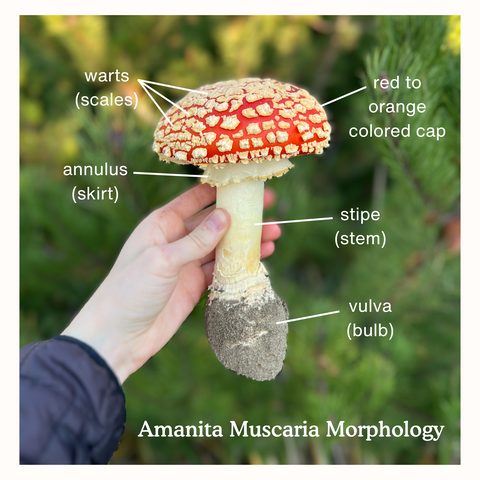
Important: Rain can wash off the warts. A mature or rain-washed Amanita muscaria may appear as a plain orange or red cap with no white spots. Don’t dismiss a capless-looking red mushroom without checking the other features.
Gills: White, free from the stem (not attached to it), fine and closely packed.
Stem (Stipe): White, 10–25 cm tall, with a distinctive ring (skirt) about two-thirds of the way up. The base is bulbous and marked with concentric rings of veil tissue (this is called the volva and is one of the most important identification features).
Volva: Concentric rings around a swollen base. This is what distinguishes Amanita muscaria from the deadly Amanita phalloides (death cap) and Amanita virosa (destroying angel). Those species have a smooth, cup-like sac at the base, not rings.
Spore print: White.
Smell: Sweet, mild, distinct.
The Lookalikes You Must Know
The Amanita genus contains some of the deadliest mushrooms on Earth. If you are new to foraging, take the time to study the following before you pick anything:
Amanita phalloides (Death Cap)
Olive-green to pale yellowish cap. White gills. White stem with a ring. But the critical difference: a smooth, cup-like sac (volva) at the base, not concentric rings. Contains amatoxins that destroy the liver. There is no antidote. A single cap can kill an adult. This is the most important lookalike to know.
Amanita virosa / Amanita bisporigera (Destroying Angels)
Pure white throughout — cap, gills, and stem. Same saclike volva. Same amatoxins as the death cap. The all-white coloration can cause confusion with Amanita muscaria var. alba (the white variant). The volva shape is the critical differentiator.
Amanita pantherina (Panther Cap)
Brown cap with white warts — the same wart pattern as muscaria. Contains ibotenic acid and muscimol in higher and more variable concentrations than most Amanita muscaria (typically 5x more). Significantly more toxic per gram and with a steeper dose-response curve. Common in Europe and some parts of North America.
The rule most experienced mycologists follow: If you cannot positively identify a mushroom to species, do not eat it. With Amanita in particular — where the edible and the deadly can grow side by side, 100% certainty is the standard, not 90%.
Where Does Amanita Muscaria Originally Come From?
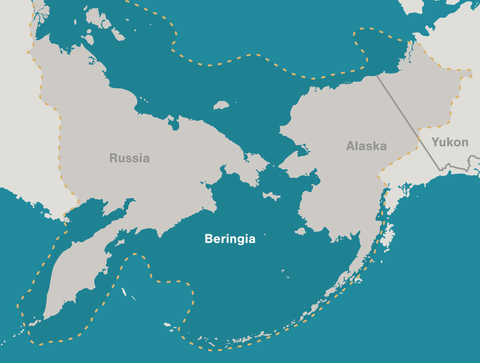
Evolutionary biologists have traced the first Amanita muscaria genetics to the Siberia-Beringian region about 3 million years ago. From there it spread in both directions. East across the Bering Straight into North and South America, and west across Europe, and eventually reaching every forested continent on Earth.
credit: hakaimagazine
A 2006 molecular phylogenetic study by mycologist József Geml and colleagues found three distinct genetic clades within Amanita muscaria, roughly representing Eurasian, Eurasian subalpine, and North American populations (with Alaska as the likely center of diversification).
There is ongoing scientific debate about whether Amanita's spread across continents was assisted by human migration or occurred via natural spore dispersal. What is known is that distinct regional lineages developed on each continent, meaning the Amanita muscaria growing in Russia is genetically distinct from the ones growing in Washington State, even though both contain ibotenic acid and muscimol. This is why many argue that each specific region produces slightly different "flavors" of experiences.
She also spread more recently through human activity, introduced to the Southern Hemisphere via imported European pine and birch trees. New Zealand, parts of South America, and Australia (where she is now illegal) all have naturalized populations that arrived within the (presumed) last two centuries.
Why the Location Affects the Potency
- The specific tree species it was partnered with
- The mineral and nutrient composition of the soil
- The elevation and climate conditions during the growing season
- The maturity at harvest: younger, button-stage mushrooms tend to be more potent
- How they were dried and stored after harvest
A Note on Proper Preparation!
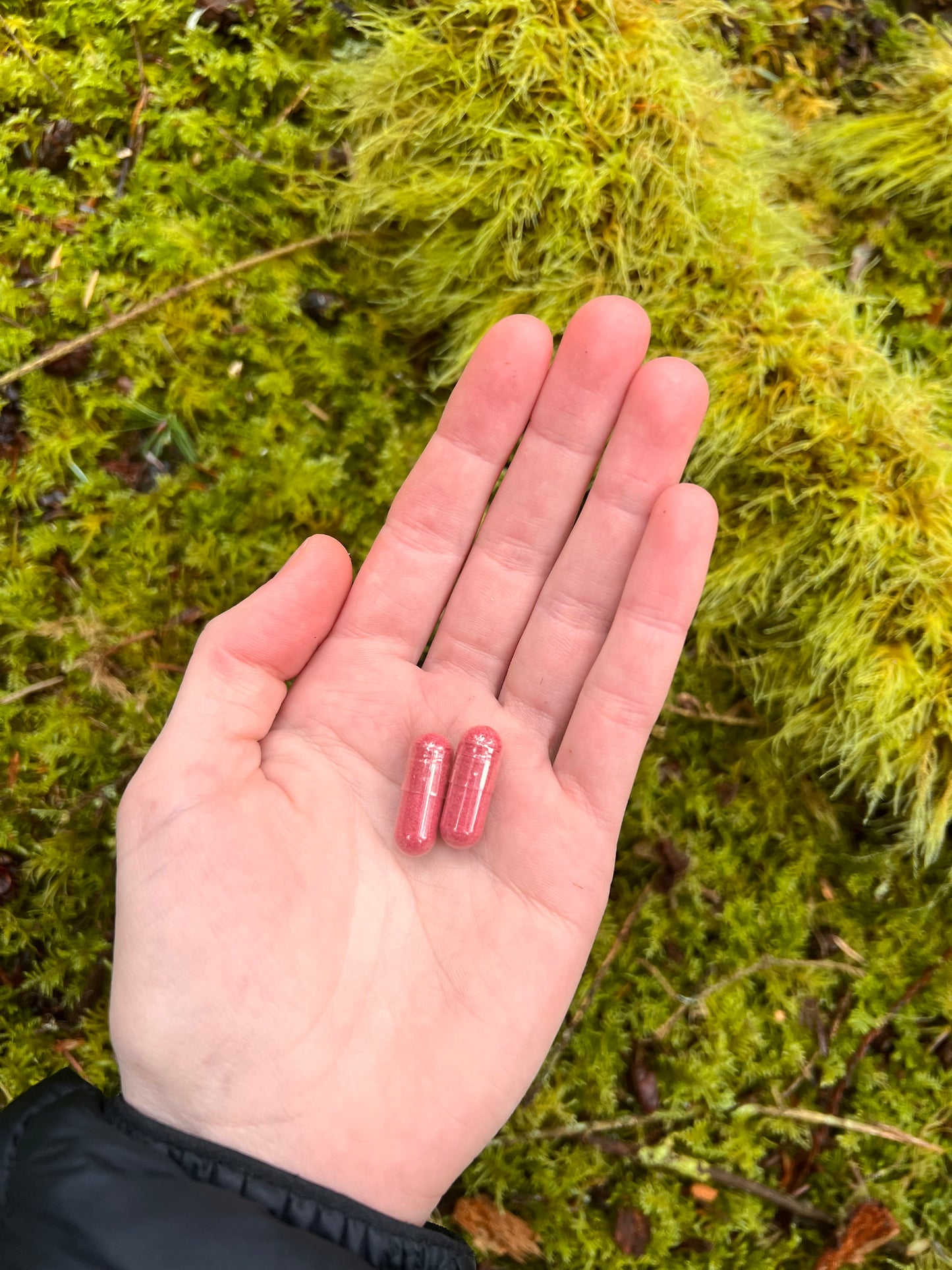
While finding Amanita muscaria is a thrill, it is vital to remember that she is not a "field-to-table" mushroom. In her raw state, Amanita contains high levels of ibotenic acid, a neurotoxin that can cause significant physical distress, including nausea, twitching, and confusion. To be used safely, the mushroom must undergo a decarboxylation process (typically through specific heat and pH-adjusted drying or boiling) to convert the ibotenic acid into muscimol, the compound responsible for its calming, GABAergic effects. Read more on decarboxylation here.
Frequently Asked Questions
Where is Amanita muscaria most commonly found in the US?
The Pacific Northwest (Washington, Oregon, northern California), the Northeast (New England, Great Lakes region), and the Rocky Mountain states all have strong populations. Amanita is present throughout most of the US except the treeless Great Plains corridor.
What trees does Amanita muscaria grow near?
Most commonly pine and birch, but she has been documented with hundreds of tree species including spruce, fir, oak, and cedar. Always look at the base of trees rather than open ground.
When is Amanita muscaria season?
In most Northern Hemisphere locations, peak season is September and December. A sustained period of rain followed by cooler temperatures is the main trigger.
Does Amanita muscaria grow in the same spot every year?
Generally yes - in the same area, though not always the exact same spot. The mycelium network persists underground year after year and continues to expand. Finding a productive location one season is a strong signal for future seasons, but not a guarantee.
How do I tell Amanita muscaria from a death cap?
The most important difference is the color on the cap and the vulva at the base of the stem. Amanita muscaria mushrooms are always yellow to deep scarlet red in color where death caps are white to greenish white. Additionally, Amanita muscaria has concentric rings at the base while death caps and destroying angels have a smooth, cup-like sac.
Can I forage Amanita muscaria from anywhere?
Legally, foraging laws vary by state, land type (public vs. private, national forest vs. national park), and region. Always check local regulations before foraging on public land. More practically: only forage from areas you know to be free of industrial contamination, heavy traffic, or chemical spraying (because Amanita is known to absorbs toxins from the) soil.