
Journal Contents:
- Intro
- How do psychedelics actually work?
- How does Amanita work?
- Why does labeling matter?
- Where does Amanita Actually Fit?
- Types of psychoactive substances.
- But it feels like so much more than that
Intro
If there's one thing I want people to know before they start working with Amanita muscaria, it’s this: she is not a psychedelic. Not in the way that word is actually defined. Not in the way your body experiences her. The comparison gets made constantly (usually by companies trying to ride the wave of psilocybin’s popularity) but it’s inaccurate, and the inaccuracy matters. It shapes expectations, affects safety, and frankly undersells what this mushroom actually is.
How do Psychedelics Actually Work?
Though psychedelic is often used as a catch all term for drugs that are “consciousness altering”, their method of action is specific.
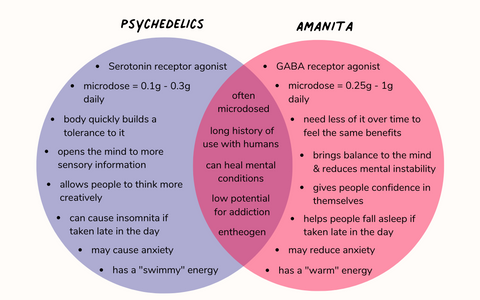
Classic psychedelics (like psilocybin, LSD, DMT, mescaline, & ayahuasca) are what researchers call "serotonergic hallucinogens". No matter which one you take, they all share a defining mechanism: they activate the 5-HT2A serotonin receptor in the brain.
When that receptor is activated, neurons that don’t normally communicate start firing together. Your brain’s internal filters lower, more sensory information floods in, and you experience the world with heightened intensity. Many experience new thought patterns, amplified emotions, visual phenomenas, a feeling of expanded awareness and connection with others and nature.
This is why taking psychedelics can feel like opening a window. More information comes in. The world gets louder, more vivid & more interconnected. This makes psychedelics perfect for altering your world view and allowing you to be more creative.
In addition, because of the way classic psychedelics bind to the serotonin receptor, they build tolerance rapidly. If you tried take a moderate dose of psilocybin for two days in a row, the second experience will most definitely be significantly blunted. Most protocols require multi-day breaks for this reason.
How Does Amanita Muscaria Work?
Amanita muscaria contains no psilocybin, no mescaline, and nothing that acts on the serotonergic system. Instead Amanita contains a molecule known as muscimol which bind to GABAa receptors and activates the GABAergic system - the main inhibitory system in the body. GABA is responsible for reducing the action of the central nervous system to help calm overactive neurons and keep the body in a state of balance.
If you want to go deeper on the neuroscience behind this, I’ve written a full breakdown in How Muscimol & Amanita Muscaria Calm the Brain.
Where psychedelics open the windows of sensory input, muscimol does something closer to the opposite. It quiets the overactive signals, the mental chatter, the ego mind that keeps you anxious, spinning, in your head and disconnected from yourself and your intuition.
This is why Amanita tends to feel much more calming, grounding, and inwardly focused than psychedelics. People who work with Amanita long term also notice a profound uplift in their mood, feeling more optimistic about their life and being more in control of their emotions and mental thoughts. Where psychedelics open the window, Amanita helps you clean up your own house so you can walk out the front door with ease.
There’s also a notable tolerance difference. Unlike psychedelics, Amanita appears to have a reverse tolerance and many people find they need to take less over time (both in quantity and frequency) as their nervous system recalibrates to the new normal.
One important note on preparation:
Raw Amanita muscaria contains ibotenic acid, which can cause nausea and agitation and is responsible for most of the negative stories you’ve heard about this mushroom. When properly dried and decarboxylated, ibotenic acid converts into muscimol — the calming, healing compound Amanita is known for. For the purposes of this article, I will only be focusing on full decarboxylated Amanita muscaria.
So Why Does the Labeling Matter?
Because the assumptions people bring to a substance shape how they use it.
Someone expecting a psilocybin-style experience from Amanita will be confused at best and unprepared at worst. The visual quality is different, the emotional character is different, the dose-response curve is different. Even experienced psychonauts report being caught off guard by how unlike a classic psychedelic Amanita actually is. They describe the Amanita trip like a lower quality psychedelic trip (more dreamy, confusing, & slow) and less like a totally unique mushroom with a more medicinal rather than recreational value.
Accurate labeling also matters legally. Amanita muscaria is legal in 49 US states precisely because it operates entirely outside the scheduling that applies to serotonergic psychedelics. Calling it a psychedelic when it isn’t conflates something legal and medicinal with something legally fraught, and can place Amanita in the crosshairs of a government that is hell-bent on robbing the populace of the free will to explore consciousness.
Labeling Amanita correctly is the first step to making sure people stay safe and amanita continues to be treated as a legal and medicinal mushroom.
Where Does Amanita Actually Fit?
Scientists have debated over the years on how to classify psychoactive substances, but they generally agree on 7 major groups. Each group is defined according to shared symptoms or pharmacological effects on the nervous system.
The 7 Categories of Psychoactive Substances
1. Narcotics
Action: Acts on opioid receptors
Effects: Pain relief, sedation, feelings of warmth and wellbeing
Examples: opium, heroin, morphine, fentanyl and oxycontin
2. Empathogens
Action: Stimulate mass release of serotonin and dopamine
Effects: Emotional openness, increased empathy, sociability, mild euphoria
Examples: MDMA, GHB and sassafras
3. Dissociatives
Action: Block NMDA glutamate receptors
Effects: Detachment from self and surroundings, dreamlike states, distorted perception of time, reduced pain
Examples: Ketamine, Nitrous, PCP
4. Cannabinoids
Action: Acts on endocannabinoid system
Effects: Relaxation, reduced nausea, anxiety, reduce pain and changes in perceptions of time.
Examples: THC and CBD
5. Stimulants
Action: Increase dopamine activity and block adenosine receptors
Effects: Heightened alertness, increased energy, elevated mood, reduced appetite
Examples: Caffeine, amphetamines, cocaine
6. Depressants
Action: Activate GABA-A receptors, reducing central nervous system excitation
Effects: Calm, relaxation, reduced anxiety, muscle relaxation, sleep support
Examples: Alcohol, benzodiazepines, KAVA
7. Psychedelics
Action: Activate 5-HT2A serotonin receptors, increasing cross-neuronal communication
Effects: Altered perception, visual phenomena, amplified emotions, expanded sense of connection
Examples: LSD, psilocybin, DMT, mescaline,

---
Based on its mechanism, decarboxylated Amanita muscaria is a depressant.
Like alcohol and benzodiazepines, it works through the GABA system, but unlike those substances, it carries none of the addiction potential, physical dependence risk associated with either. Understanding this distinction is also what makes drug interactions with Amanita so different from those with classic psychedelics.
But It Feels Like So Much More Than That
It does. And that’s exactly what the pharmacological label misses.
Amanita muscaria has been used for thousands of years not just as a relaxant, but as a sacred entheogen, a vibrational medicine used to access spiritual states, deepen self-understanding, and feel genuinely connected to something larger than yourself. Many people who work with her describe a quality that feels alive and intentional, as if she meets you exactly where you are and gives you what you need rather than what you expect.
Which is why the most honest description is this:
Amanita muscaria is an entheogenic depressant.
Mechanistically a depressant. Spiritually an entheogen. And categorically unlike anything else. She is not about escaping reality. She’s about coming back home to yourself, and that is what makes Amanita so special.

Frequently Asked Questions
Who is Amanita best for?
Those who are more sensitive or tend to have anxiety, trouble sleeping or low self esteem may prefer Amanita over psychedelics. Plus Amanita seems to uplift people with a gentle, warm energy over the more "buzzy" energy that comes with psychedelics.
Does Amanita muscaria get you high?
Not in the way most people expect. At microdose levels, the effects are sub-perceptual. You won’t feel high, but over time you may notice a steadier mood, less anxiety, better sleep, and a greater sense of ease in yourself. At higher doses the effects become more pronounced, but even then the experience is fundamentally different from classic psychedelics, more dreamlike and inward than visually intense.
Is Amanita muscaria legal?
Yes, Amanita is legal in 49 out of 50 US states and most countries around the world. Because its active compounds (muscimol and ibotenic acid) are not scheduled substances, Amanita muscaria occupies a completely different legal category than psilocybin mushrooms. The one exception in the US is Louisiana. See our full legal guide here.
What does Amanita muscaria feel like?
Most people describe a sense of calm, mental clarity, and emotional groundedness. Some notice reduced anxiety, improved sleep, and a quieter inner critic. It doesn’t produce the visual intensity or emotional amplification associated with psychedelics — it’s less like opening a floodgate and more like finally being able to hear yourself think.
Can you take Amanita muscaria if you’ve used psychedelics before?
Yes, and many people who come to Amanita have a psilocybin background. The main thing to know is that the experience is genuinely different so it's best to not bring the same expectations. Amanita works subtly and cumulatively, especially as a microdose. Give it at least three weeks of consistent use before drawing conclusions.
Is Amanita muscaria safe?
When properly prepared (fully decarboxylated to convert ibotenic acid into muscimol) and taken at microdose levels, Amanita muscaria has a strong safety profile. The negative stories you’ll find online are almost always linked to raw or improperly prepared mushrooms, or significant overconsumption. Read more about our preparation process here.